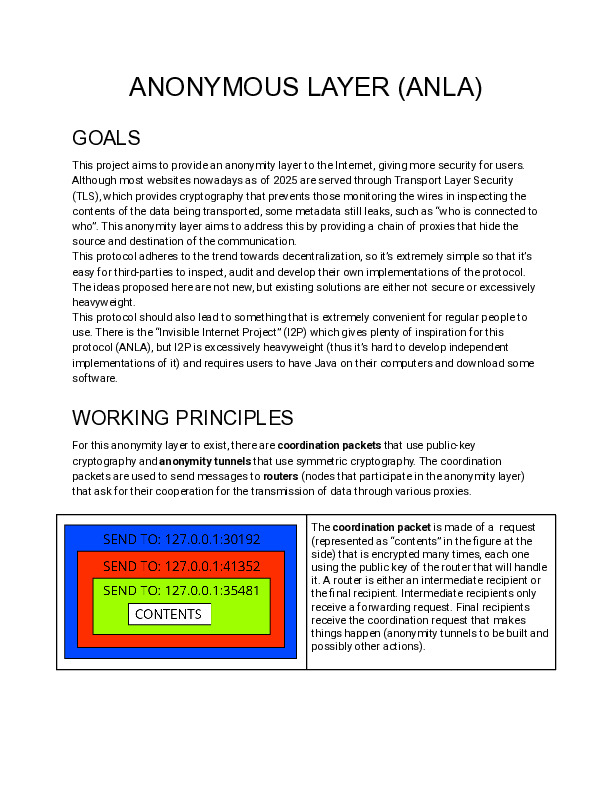
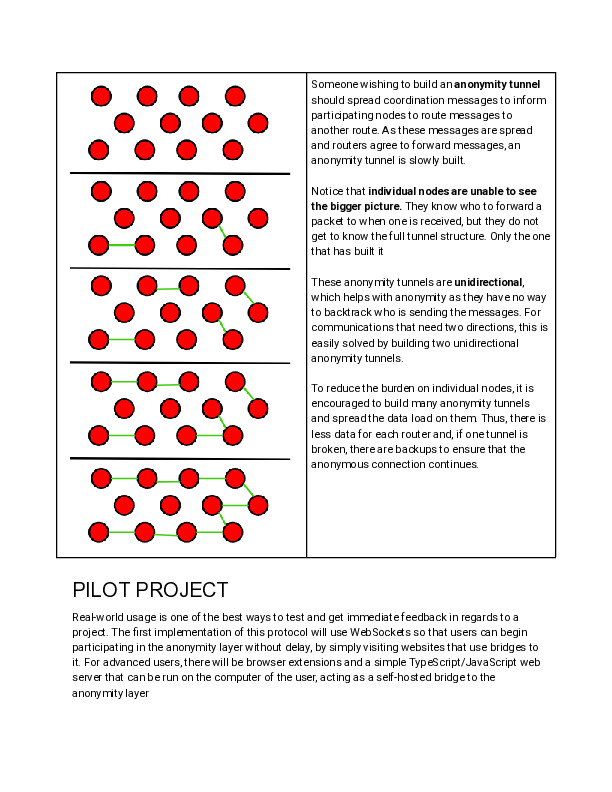
I’m looking for a grant to develop an anonymity layer for the Internet. This would benefit Litecoin, as the flourishing of marketplaces and social networks would push for a circular Litecoin economy, reducing the supply of it that is converted to fiat currency. Tor doesn’t count as an existing solution because it is a honeypot, a backdoor funded by the U.S. military with a lengthy track record of security vulnerabilities, possibly deliberate. Here are some pages of a document that I’m writing. If you know someone that sees values in this initiative and it could lead to business, please link me with that someone.
1 Like
isn’t MWeb taking care of that?
Developing an app is not the issue, bigger issue is to make it known, cutting thru the noise is expensive.
1 Like
No, I’m not talking about MWEB. It’s not about making private cryptocurrencies, but private marketplaces and social networks. The markets that are on the open Internet are exposed to law enforcement (seizure of domain, blocking the IP address). The plan here is to make an anonymity network where that comes either extremely hard or downright impossible.
1 Like
The domain Seizure has nothing to do with security levels.
There are Domain Seller who need a court order, and there are domains where even that is not enough. .onion Network i.e.
You need to look into offshore hosts and not security levels.
1 Like
.onion Network
As I have said before, Tor is a honeypot funded by the U.S. military. I’ve abandoned Tor all the way back in 2014. Not only that, Tor is bloated and it’s hard to develop independent implementations of it. As recently as 28th of October, yet another critical vulnerability in Tor was patched. That is their modus operandi: “place a sneaky security vulnerability in one version”, “hit their targets”, “remove vulnerability in next version”. Tor only tricks people into thinking that they are private, luring people that are “person of interest” relative to government to fall for their trap.
1 Like
That was only one part of the argument. The other is offshore hosts.
I refuse to believe that the US Military invented or set up the onion network. Conspiracy beliefs I leave to other people,

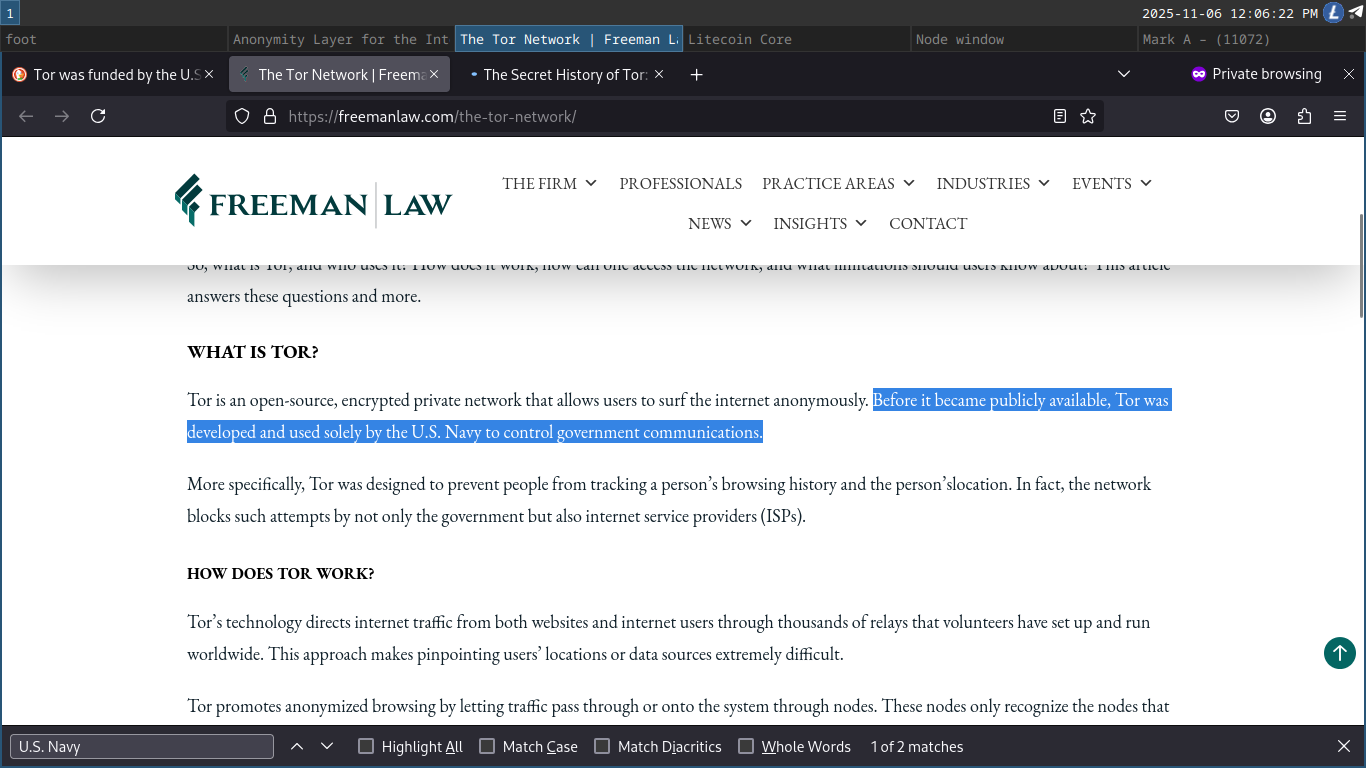
As I said I’m not a friend of conspiracy theories and those posted classify as such.
Why do those classify? Because they are a one man guess. Not a MIT Output but a output of a person who has access,
Surely the navy, the Russians, and most other country’s spy network have some nodes but did they “invent” it? Not in my eyes.
The core principle of Tor, known as onion routing, was developed in the mid-1990s by United States Naval Research Laboratory employees, mathematician Paul Syverson, and computer scientists Michael G. Reed and David Goldschlag, to protect American intelligence communications online. Onion routing is implemented by means of encryption in the application layer of the communication protocol stack, nested like the layers of an onion. The alpha version of Tor, developed by Syverson and computer scientists Roger Dingledine and Nick Mathewson and then called The Onion Routing project (which was later given the acronym “Tor”), was launched on 20 September 2002 The first public release occurred a year later.
I can see where you coming from, but it is a long stretch from United States Naval Research Laboratory employees to being developed by the navy.
That being said, Offshore is the way to go. It is not 100% as there is no 100% security on the www. You connect, you can be hacked, you also can be seized. If you buy a domain investigate the seller if they have a clean sheet or have they been compromised.
And that does not even mean 100% either, they might just not telling.
Good luck with your project. When talking to some grand people be more careful not get hooked on just one item in a 2 item story.
1 Like
To better understand this, I have two questions:
- Where does your layer fit in on the typical OSI networking model?
- How does a new router establish awareness of participating routers?
1 Like
Where does your layer fit in on the typical OSI networking model?
In the transport layer (together with TCP, UDP, SCTP). Today, this can be implemented on top of existing protocols (TCP, UDP, SCTP), but in a far future it could be its own protocol.
How does a new router establish awareness of participating routers?
There is no definitive answer for this. In fact, there are advantages for not all nodes being visible to each other, which is why although some nodes being visible is required for usability, all nodes being visible may be undesirable. I think of these solutions:
- routers advertising themselves through plug-and-play
- routers advertising other routers
- advertisements embedded in the control packets
1 Like
@Nickz, let me remind you that, even six years ago, notorious dark markets such as “Libertas Market” have abandoned the Tor network in favor of I2P. In fact, if I2P wasn’t so heavyweight of a protocol, I wouldn’t be doing my pitch. I2P is the only serious competition to what I’m proposing.
Well many people react too harshly and with reasons bordering paranoia.
There are layers but most work over the dreaded and welcome IP. So your layer can be closed down by seizing the IP. IP is a translation of the numbercode into a domain name.
So your layer can be closed down by seizing the IP
The anonymity layer is exactly to prevent this from happening. Users will be shielded by having their real IP addresses concealed through many proxies.
1 Like
Those layers do depend on the IP. What makes you think your IP is saver?
The law enforcement put you a piston on you sin and you spit those IP out double quick.
The grand you are expecting to fetch? How much, and what for?
Those details are missing here.
1 Like
Okay, thanks. Are the channels being built dynamically per packet, or are they established for a session, like TLS? If the former, then the overhead would be extremely large. If the latter, then I think it’s the Session Layer.
That Matruschka Doll model of encryption mixed with channels reminds me of the Lightning Network.
1 Like
You should make your arguments without this term, which is a slur nowadays, and used to shut down debate in a midwit kind of way.
1 Like
So be it. The post initiated with one. There is a need to call something out even if that offends someone. Nowadays there is a conspiracy lurking in every corner.
A layer will not give security if its build on something fixed.
The channels are established for a session. The tunnels use symmetric cryptography (faster, less overhead), the packets use asymmetric cryptography (slower, more overhead).
Nobody is offended. Slurs just signal a lack of thinking and bring down the quality of the whole discussion.
I think there’s something confusing me, and it’s the term ‘packets’. Admittedly, this is quite confusing in TCP/IP itself. One has packets within packets. I think you are meaning the term metaphorically, like ‘package’. This is because the ‘tunnel’ you mention would really be the ultimate ‘packet’ with the header to route the encrypted packets (the payload).
Could we clarify the term ‘packet’ and also relate it more to the TCP/IP stack? It seems to me you are describing a new session layer, like a VPN. You say that you could change TCP or UDP in the future, but that seems unnecessary if you are encrypting the payload. TCP would not leak metadata en route, because it is encrypted.